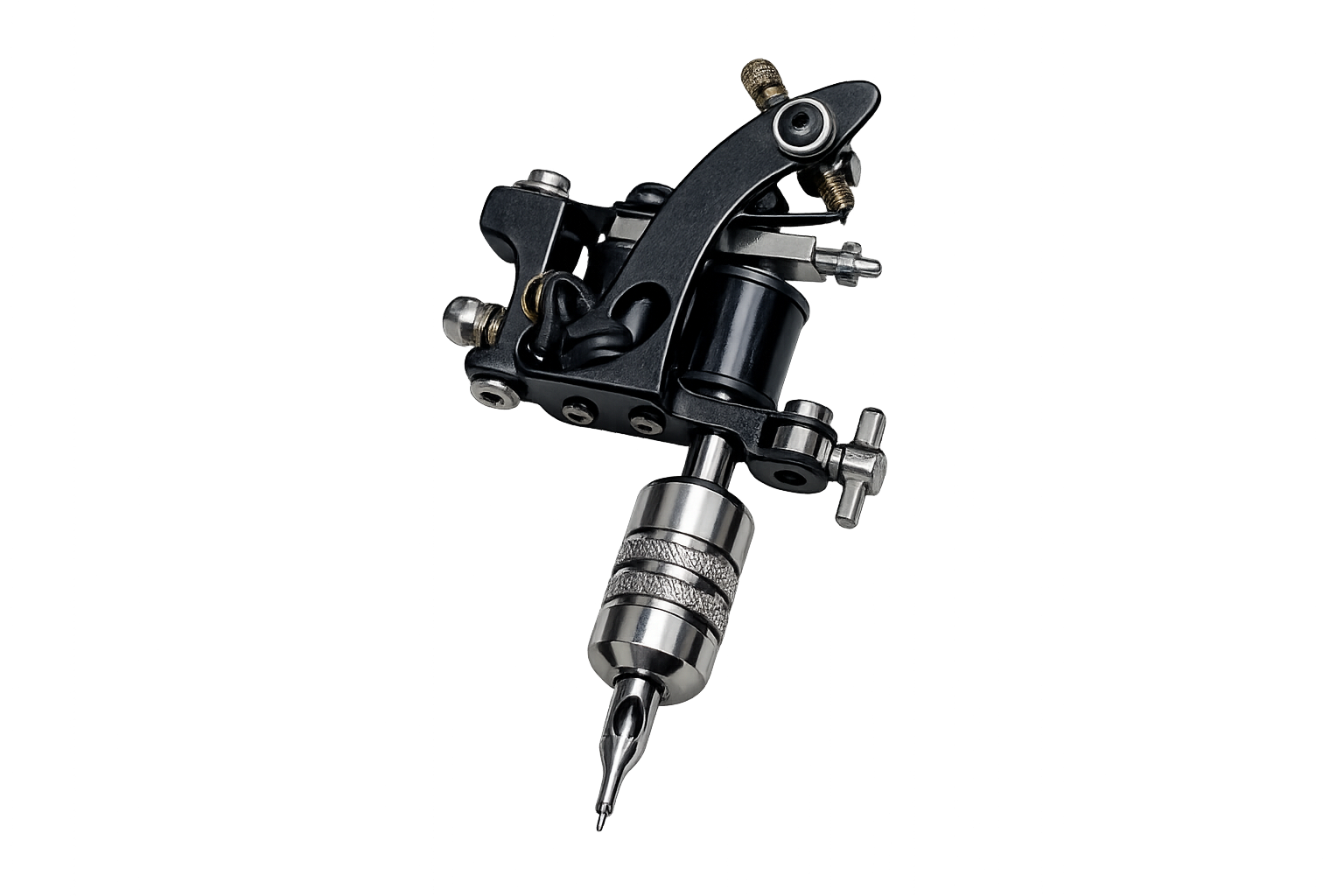
Tattoo Machine Basics
If you have never held a tattoo machine before, this is the place to start. Learn what makes the needle move, what the controls mean, how the parts fit together, and what to check before you practice.
1. What Does a Tattoo Machine Actually Do?
All electric tattoo machines perform the same essential job: they drive a needle grouping rapidly in and out. The needles carry pigment into the dermis, the layer beneath the outer epidermis. The motor or electromagnetic mechanism creates the movement; the artist controls the position, direction and time spent in each area.
The machine does not automatically know the right depth or speed. It cannot sense when a line is too deep. Needle selection, hand movement, machine settings, skin condition and technique all affect the outcome.
2. Rotary, Pen and Coil Machines
Rotary machines
A small electric motor rotates a cam or drive mechanism that converts circular motion into the back-and-forth movement of the needle. Rotary machines are often lighter and quieter than traditional coil machines, and many require less mechanical tuning.
Pen machines
A tattoo pen is usually a rotary machine in a pen-shaped housing. The motor sits inside the body, and many models accept sealed needle cartridges and let you adjust how far the needle protrudes by turning the grip. Some pens have a fixed stroke; others offer adjustable stroke lengths.
Coil machines
Electromagnetic coils attract a metal armature bar. The movement opens an electrical contact, the magnetic field collapses, and springs return the bar to its original position. The circuit makes and breaks repeatedly, producing the characteristic buzzing sound and driving a traditional needle bar. Coils can work very well, but assembly and tuning are more involved.
For a complete beginner: a reputable cartridge-compatible rotary pen is usually the simplest type to learn on, because there are fewer exposed mechanical parts to adjust. That does not make it automatically safe for use on people.
3. Learn the Parts Before You Switch It On
- Machine body: houses the motor or coil mechanism.
- Grip: the part held in the hand; may adjust needle protrusion.
- Cartridge: a replaceable needle unit, ideally with a protective membrane appropriate to the machine.
- Drive bar or plunger: transfers motion into a cartridge needle.
- Power supply / battery: provides the voltage required by the particular machine.
- RCA cable, clip cord or foot switch: used on some corded machines.
- Barrier cover and grip wrap: help protect controls and surfaces from contamination; do not replace cleaning.
Cartridges, grips and drive systems are not universally interchangeable. Check the exact machine and cartridge manufacturer's compatibility guidance. Never force a cartridge into an incompatible grip or run a damaged machine.
Traditional coil machines also have an armature bar, contact screw, springs, coils and often a capacitor; their setup differs substantially from a cartridge pen.
4. Voltage, Stroke, Give and Needle Hang
Voltage and speed
Voltage controls electrical input to many machines and generally changes how quickly the mechanism cycles. It is not a universal indicator of how hard a machine hits. Two machines can behave differently at the same voltage. Start with the manufacturer's recommended operating range, and learn how the machine behaves on practice skin. Do not copy a voltage from a video without checking your model.
Stroke length
Stroke is the distance the needle drive travels during a complete cycle, often expressed in millimeters. A medium stroke, around 3.5 mm, is common on general-purpose rotary pens, but machines and intended uses vary. Some machines have fixed strokes; some allow adjustment. Stroke is a property of the mechanism, not a measurement of how deep you should puncture skin.
Needle hang
Needle hang or protrusion means how far the needle extends past the cartridge tip or tube at the forward end of its movement. A twist grip often adjusts this. Protrusion is not the same as penetration depth: actual penetration also depends on hand position, pressure, skin resistance and movement. Increasing protrusion is not a safe fix for poor ink delivery.
Give, needle groupings and hand speed
Give describes how much the mechanism yields under resistance. Needle groupings describe the number and arrangement of needles, such as round liners and magnums. Hand speed is how fast you move the machine across the surface. These variables interact, so there is no single ideal combination for every machine, person or technique.
5. Your First Machine Test: Use Practice Skin
- Read the manual. Identify the exact model, approved power range, battery/cord connections, cartridge type, grip adjustment and cleaning requirements.
- Inspect everything. Check the machine, cable, grip and cartridge packaging for visible damage. Never use a damaged, contaminated or previously used needle.
- Prepare a clean station. Use the procedures in our Setup Guide and Hygiene Guide. Use appropriate barriers and gloves.
- Power off before fitting a cartridge. Insert only the compatible cartridge following your machine's instructions. Keep the sterile needle tip from touching unintended surfaces.
- Set up on synthetic practice skin. Secure the practice material, turn on the machine at a manufacturer-approved starting setting and observe its motion, sound and vibration.
- Practice control. Make simple straight lines, curves and even passes on synthetic material. Concentrate on a steady grip, comfortable posture and deliberate movement rather than speed.
- Stop and assess. If the machine rattles unusually, becomes excessively hot, stalls, or the cartridge behaves unpredictably, power it off and consult the manual.
Do not move directly from practice skin to human skin without training in sanitation, bloodborne pathogens, legal obligations and supervised technique.
6. Common Beginner Questions
Why won't the machine start?
Check that its battery is charged or the approved power supply is connected, the switch/foot control is active, and all connections are seated. Do not bypass safety features or exceed the stated power range.
Why is the needle not moving correctly?
Turn the machine off. Verify that the cartridge is compatible and fully seated, the grip is properly attached, and the drive mechanism is unobstructed. Do not attempt internal repairs on a powered machine.
Can I clean the whole machine in water?
Generally, no. Motors, batteries and electronics should not be submerged unless the exact model's manufacturer specifically authorizes it. Ultrasonic cleaning is not sterilization. See our Hygiene & Ultrasonic Cleaning section for details.
What machine should I buy?
Choose a model with documented support, compatible sterile cartridges, accessible replacement parts and clear cleaning instructions. See our Gear Guide for a broader overview.
Tattoo Machine Basics: Video Tutorials
Watch explanations of machine types, stroke length and traditional coil setup. Choose a tutorial from the scrollable list on the right. These are independent creators; compare all settings against your own machine manual.
A comparison of traditional coil machines, rotary machines and pen machines.
Watch directly on YouTube