Start Here
- Legal Responsibility
- Cleanliness and Safety
- Tattoo Machines
- Needle Depth
- Angle and Stroke
- Overworking the Skin
- Needle Groupings
- Basic Techniques
- Placement
This page exists to establish the basic safety principles and responsibilities involved in tattooing. Tattooing is not just drawing on skin. It is a process that inserts ink beneath the outer layers of the skin and creates an open wound.
If performed improperly, tattooing can cause infection, injury, or permanent damage. The purpose of this guide is educational. You are responsible for how you apply the information.
Legal Responsibility
Before tattooing anyone — especially another person — you must understand the laws where you live.
Regulations for tattooing vary widely depending on:
- Country
- State or province
- County or district
- City or municipality
Some locations require licensing, training, bloodborne pathogen certification, or health department inspection.
Never assume the rules are the same everywhere. Always verify your local regulations before performing tattoos.
Cleanliness and Safety
Tattooing introduces ink beneath the surface of the skin using needles. This process creates a small but real open wound.
Because of this, cleanliness is critical.
- Work surfaces must be clean and disinfected
- Needles should always be single-use
- Ink should come from a reputable manufacturer
- Gloves should be worn during tattooing
- Contaminated equipment must never be reused
Infections most commonly happen when sanitation is ignored. Good habits prevent problems.
Tattoo Machines
Most modern tattoo machines fall into two major categories.
Coil Machines
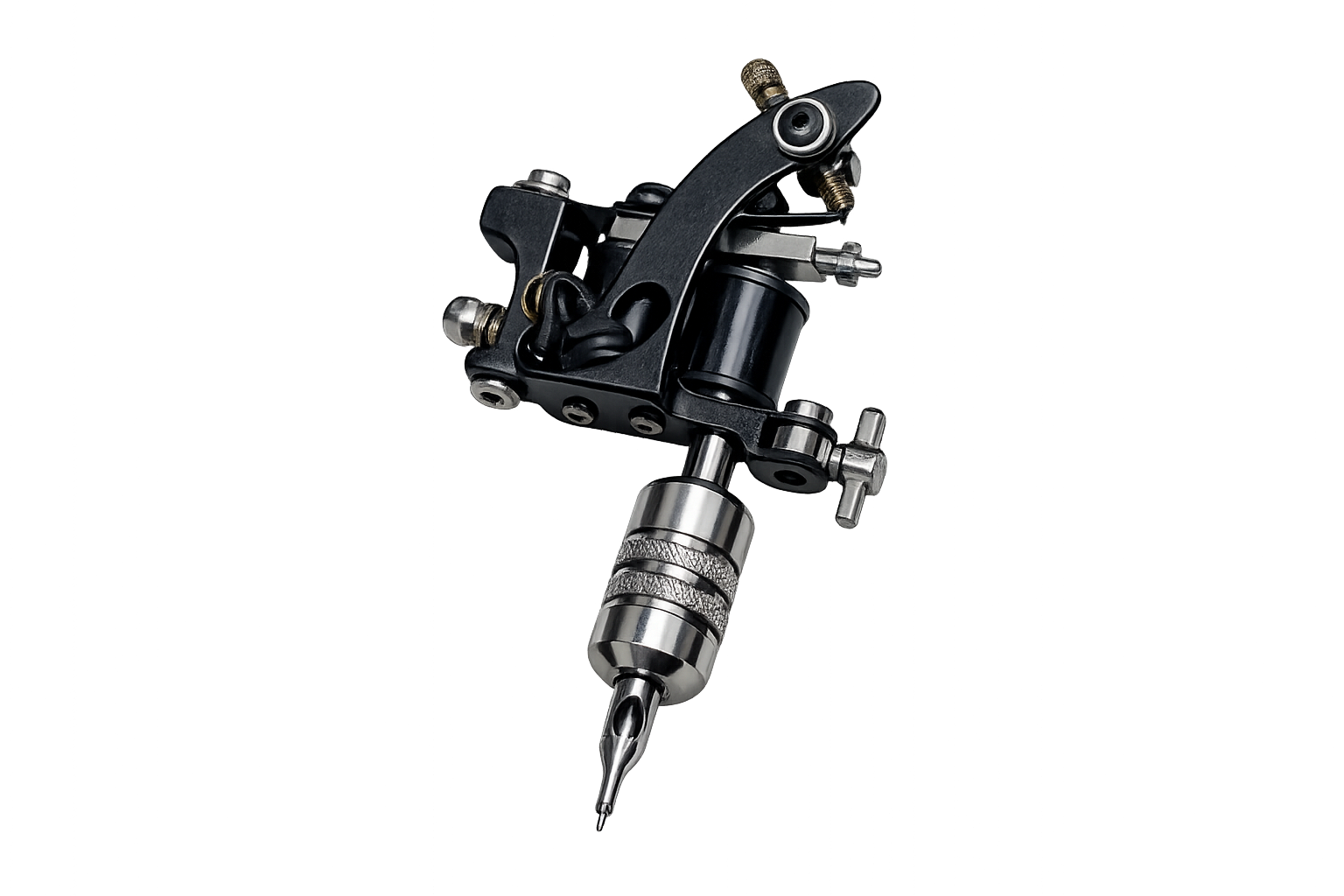
Coil machines use electromagnetic coils to pull an armature bar up and down, creating the needle movement. They are traditional and often preferred for lining due to their strong hit and adjustable tuning.
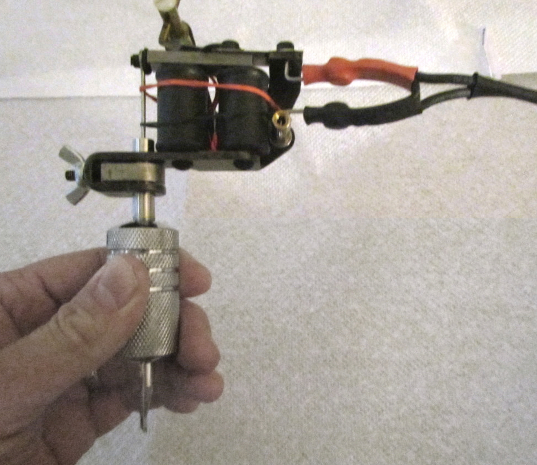
I would reccomend against using coil machines to beginners if you have the option. After you understand how a coil machine works it becomes straightforward. But the first time you see one it can look confusing. There is much more to set up than a rotary machine. Make sure to look up some videos on how to set up a machine before attempting it.
Rotary Machines
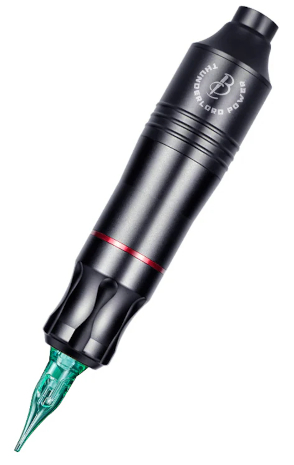
Rotary machines use a small electric motor to move the needle in a circular motion that converts into vertical movement. They tend to run smoother and quieter than coil machines.
Both machines can produce excellent work when properly set up.
Needle Depth
The needle should penetrate deep enough to deposit ink into the dermis, the layer of skin beneath the outer epidermis.
In most cases this depth is roughly 1.5–2 millimeters below the skin surface. Many artists use about 2 mm as a practical rule of thumb.
If the needle goes too shallow, the ink sits in the epidermis and will fade as the skin heals. If it goes too deep, it can cause unnecessary trauma, scarring, or blowouts where the ink spreads under the skin.
Maintaining consistent depth is one of the most important skills in tattooing and improves through proper machine setup, good hand control, and careful practice.
Angle and Stroke
The machine should generally be held at a slight angle rather than straight up and down.
Maintaining a steady motion and consistent speed helps the needle deposit ink evenly.
Machine stroke length and hand speed must work together. Moving too slowly can overwork the skin, while moving too quickly can cause inconsistent lines.
Overworking the Skin
Overworking the skin is a major concern when tattooing. It is common for beginners to want to go back over the same area repeatedly to correct a line or improve saturation.
Ideally, an area of skin should be tattooed once. A small number of touch-ups may be necessary, but you should generally avoid going over the same spot more than two or three passes.
Continuing to work the same area beyond that point begins to damage the skin. When skin is overworked it can become excessively irritated, bleed more, and heal poorly.
If tattooing continues on overworked skin, the tattoo may form heavy scabs during healing and can even lead to scarring or infection.
Clean technique and controlled passes will produce better results and allow the skin to heal properly.
Needle Groupings
Needles used in tattooing are arranged into groupings that determine how ink is delivered to the skin. The grouping affects how wide the mark is, how much ink is deposited, and how fast you can work an area.
Needle sizes are often labeled with numbers such as 1003 or 1203. The first two numbers refer to the needle diameter (for example 10 gauge or 12 gauge), and the last two numbers refer to how many needles are in the grouping.
For example:
- 1003RL — 3 needle round liner using a #10 diameter
- 1203RL — 3 needle round liner using a slightly thicker #12 diameter
- 1207M1 — 7 needle magnum for shading or color packing
The most common grouping styles include:
- Round Liners (RL) — tightly grouped needles designed for creating lines
- Round Shaders (RS) — looser round groupings used for softer shading
- Magnums (M1 / M2) — wide needle groupings used for shading and filling larger areas
- Flats (F) — needles arranged in a straight line, often used for certain shading techniques
Although liners are designed for outlining, it is possible to create lines using other groupings as well. For example, some artists will use the edge of a magnum to produce a line effect, and round shaders can also be used for softer lines.
A general guideline is to use the largest needle grouping appropriate for the area of skin you are working on. Larger groupings distribute ink more efficiently and reduce the need to repeatedly pass over the same area.
Typical examples include:
- Small lines: 3RL or 5RL
- Medium lines: 7RL
- Shading: 7RS, 9RS, or small magnums
- Color packing: 7M1, 9M1, 13M1 and larger
The correct grouping also affects machine speed, hand movement, and how quickly ink saturates the skin.
Basic Techniques
Lining
Lining is the process of creating the outlines of a tattoo using a liner needle grouping. The goal is to produce clean, solid lines with consistent depth and movement.
Lining ink is typically thicker and more concentrated than shading ink. The higher pigment density helps produce solid, bold lines that remain visible after healing.
When lining, maintain a steady hand speed and consistent needle depth. Stretching the skin properly and moving the machine smoothly will help produce clean lines.
Shading
Shading adds depth, gradients, and soft transitions within a tattoo. This is usually done using round shaders or magnum groupings.
Shading ink is often diluted compared to lining ink. Many artists begin with a light mixture, sometimes around 20% black, and gradually build darker tones through multiple passes.
The goal is to slowly build value rather than forcing too much pigment into the skin at once.
Color Packing
Color packing is the process of filling areas with solid pigment. This is typically done using magnum groupings because they distribute ink efficiently across larger surfaces.
A common technique involves small circular or oval motions while gradually expanding outward from the area already filled.
Working in controlled overlapping passes helps evenly saturate the skin and prevents patchy areas.
Placement
Tattoo placement can be important, especially for someone who does not already have many tattoos.
Certain areas of the body are more often exposed to others, and the person getting the tattoo might not realize the attention their tattoo will get them if placed in a certain area.
For example, the backside of the forarm might seem like a good place for someone to get their first tattoo, but actually this area is seen a lot during casual conversation when you are say resting your head in your hands, and might actually not be a great place for someone's first tattoo.
The inside of the right wrist stands out visually when shaking someone's hand. Again, this might not be the best place for someone's first tattoo.
Any face tattoo, or neck tattoo even, will probably change the way people look at you. People should really consider the decision to tattoo these areas for a while before going through with it.
If someone is not totally sure about if they want to commit to a tattoo, they should try putting it on with transfer paper and seeing how it changes peoples reactions to them.