Techniques
- Lining
- Shading
- Color Packing
- Traditional Tattoo Style
- Watercolor Tattoos
- Stipple / Pepper Shading
- Stick and Poke
- Tapping Technique
Lining
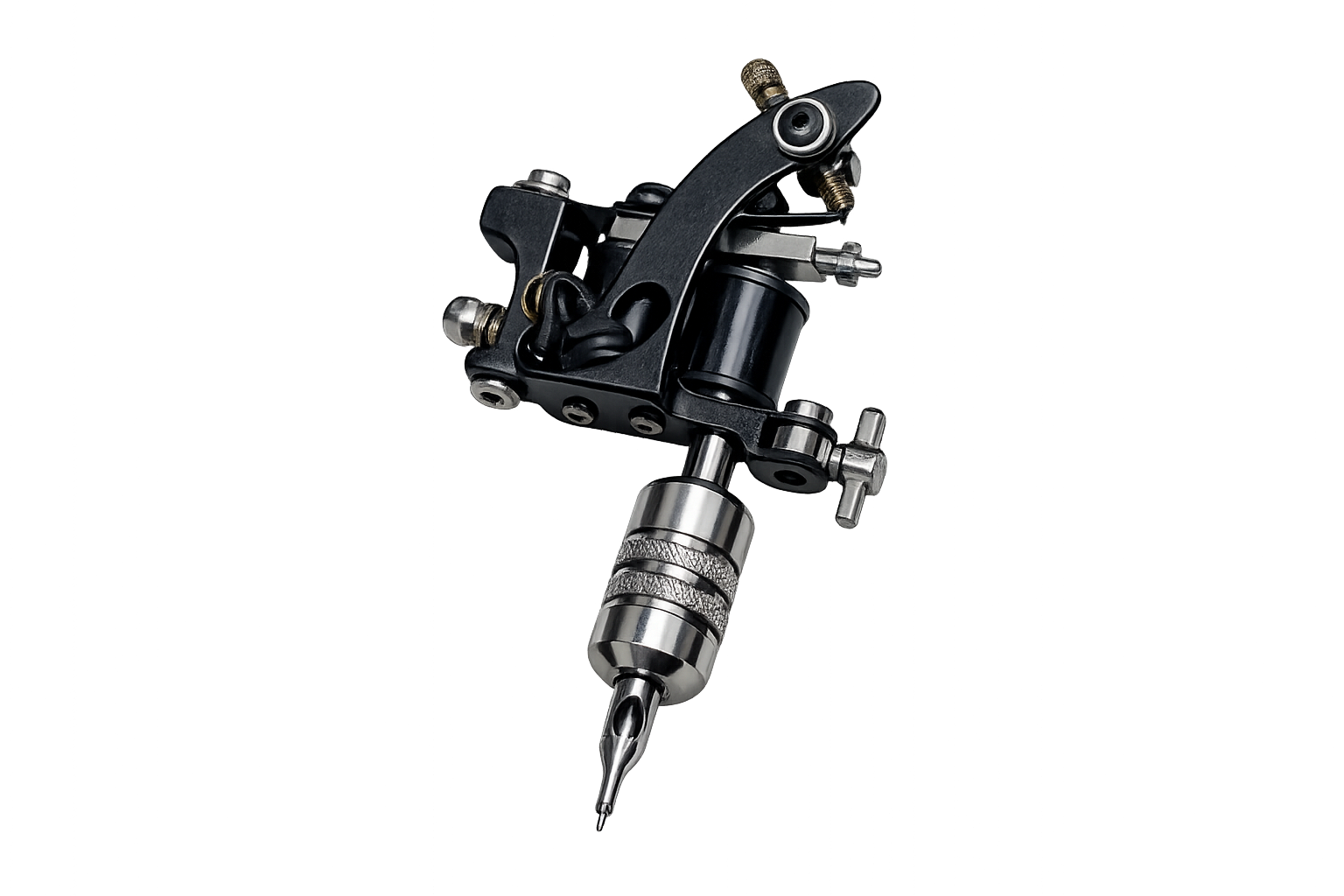
Lining creates the structural framework of a tattoo. Most artists use round liner needle groupings such as 3RL, 5RL, 7RL, or 9RL depending on the thickness required.
Typical machine settings for lining run faster than shading. The goal is to deliver clean, consistent pigment lines without excessive trauma to the skin.
Key technical points:
- Stretch the skin in three directions to keep the surface firm.
- Maintain a consistent needle depth of roughly 1–2 mm into the dermis.
- Move your hand at a steady speed so the pigment deposits evenly.
- Do not “trace slowly.” Slow movement causes blowouts and thick lines.
Common mistakes:
- Overworking the same line repeatedly.
- Running the machine too slow which causes patchy lines.
- Holding the needle too shallow which results in fading.
Shading
Shading adds depth and gradient transitions. It is commonly done with magnum needles such as 7M1, 9M1, 11M1 or curved mags.
The motion used is usually circular or whip shading.
Typical approaches:
- Whip shading: The needle enters the skin and lifts out in a flicking motion, creating a gradient.
- Circular shading: Small circular hand movements build soft gradients.
- Brush shading: Light back-and-forth movements used in black and grey work.
Good shading requires gradually building tone rather than trying to achieve full darkness in a single pass.
Color Packing
Color packing fills areas with solid pigment. Magnum needles are typically used because they distribute pigment evenly across wider surfaces.
Technical considerations:
- Use tight circular motions to push pigment into the dermis.
- Work methodically across the fill area to avoid patchiness.
- Keep the skin stretched firmly to avoid uneven deposits.
Poor color packing often results in faded or uneven color after healing. Many beginners do not push pigment deep enough or fail to overlap passes properly.
Traditional Tattoo Style
Traditional tattoos (often called American Traditional) rely on bold outlines and limited color palettes.
Typical characteristics:
- Heavy black outlines
- Simple shading
- Strong color contrast
- Limited detail
Common needle choices include 9RL or 11RL for outlines and medium mags for color fills.
Watercolor Tattoos
Watercolor tattoos mimic paint brush effects. Instead of strong outlines, artists often rely on soft color gradients and splatter effects.
Key techniques include:
- Layering diluted pigments
- Using whip shading for color fades
- Combining multiple hues to simulate brush strokes
This style requires careful pigment control because overworking the skin can muddy the color transitions.
Stipple / Pepper Shading
Stipple shading (also called pepper shading) builds images using thousands of tiny dots instead of solid shading.
This technique is common in blackwork and illustrative tattoo styles.
Technical aspects:
- Use smaller liners such as 3RL or 5RL.
- Vary the density of dots to create gradients.
- Keep consistent spacing between punctures.
The final effect creates a textured look similar to engraving or pen-and-ink illustrations.
Stick and Poke
Stick and poke tattoos are created without an electric machine. The needle is manually dipped in ink and pushed into the skin repeatedly.
Key considerations:
- Maintain consistent needle depth.
- Follow stencil lines carefully to avoid drifting.
- Work slowly to ensure even pigment placement.
This method has existed for centuries and is still used in many traditional tattoo cultures.
Tapping Technique
Tapping is a traditional hand tattooing method used in cultures such as Polynesian tattooing.
The process involves a needle comb attached to a handle that is tapped with a second stick to drive the needles into the skin.
Important aspects include:
- Precise rhythm between the tapping tool and needle comb.
- Consistent spacing to maintain line quality.
- Deep cultural traditions and ceremonial meaning in many regions.
This technique predates modern tattoo machines and remains an important part of traditional tattoo practices worldwide.